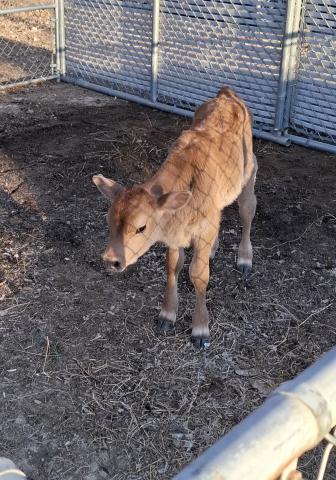
Ferdinand – The Dairy Bull with a Heart of Gold

Ferdinand is more than just a bull calf — he’s a personality. A presence. A story all his own. Believed to be a Jersey or Jersey-cross cull calf from a dairy operation, Ferdinand came to us small in size but already full of soul. Judging from his refined head, large eyes, compact frame, and caramel-tan coat with soft dark points, he likely has Jersey lineage, but nothing is confirmed.
At the time of his arrival, he stood about 24 inches at the shoulder, no more than 80 pounds — just a baby. But you could already see he’d be special.
Emily’s Ferdinand
From the moment Emily laid eyes on him at Shane Turner’s farm in Rives, there was no going back. She crawled right into the kennel with him and sat beside him for over an hour. No hesitation. No plan. Just care — the kind that comes naturally when something feels meant to be.
She refused to load him into another kennel for the trip home. Instead, Ferdinand rode in her lap the whole way — nestled close, warm, and safe. He made it almost all the way, too… until about a tenth of a mile from home, when he left a “gift” on the inside door handle. The timing was hilarious. The memory is permanent.
Personality and Place
Ferdinand has a charm that’s hard to miss. When Emily comes around, he lifts his head and gives the loudest, most expressive “moo” — as if yelling, “Mom!” It’s impossible not to laugh. He’s affectionate, curious, and deeply bonded to his humans and his herd.
He doesn’t get full pasture access just yet — he’s still young, and we're taking it slow. But in the meantime, he proudly serves as the Grain Bin Guardian, overseeing daily activity from his spot near the feed station. It’s his post, and he takes it seriously.
His favorite companion is Harlan, one of our buck goats. The two can often be found lounging nearby or poking around the same corner of the pen like old friends. And he’s frequently visited by Sadie and Mr. Hanley, who swing by his gate at supper time for a sniff, a snort, and maybe to share a little hay gossip.
Our Gentle Giant-in-Training
We don't know how big Ferdinand will grow, but his heart is already too big to measure. He’s sweet, social, and unmistakably loved. He’s proof that cull calves aren’t cast-offs — they’re opportunities to build bonds, save lives, and raise animals with meaning.
Ferdinand is family — plain and simple. The moo that melts hearts, and the bull calf that claimed a pasture… and our hearts.
Field Notes and Search Focus
We keep this guide practical for folks running real farms. The focus here is homesteading systems and self sufficiency, with clear steps and neighbor-tested lessons from day-to-day work. 🌱
Related Topics We Cover
farm planning, self sufficiency strategy, homestead workflow, small farm operations, family farm systems.
Questions Folks Ask Us
- how to organize a working homestead for daily reliability
- best way to plan labor and chores on a small farm
- how to start self sufficient systems on rural property
- what to prioritize first on a growing homestead
- how to build farm routines that scale over time
Related Farm Guides
- See our guide on Home
- See our guide on Au
- See our guide on Fh
- Read the full cornerstone guide for this topic cluster
FAQ
How to organize a working homestead for daily reliability?
Start with a phased setup, validate in field conditions, and document maintenance as you go. That approach keeps homesteading systems and self sufficiency reliable and easier to scale.
Best way to plan labor and chores on a small farm?
Start with a phased setup, validate in field conditions, and document maintenance as you go. That approach keeps homesteading systems and self sufficiency reliable and easier to scale.
How to start self sufficient systems on rural property?
Start with a phased setup, validate in field conditions, and document maintenance as you go. That approach keeps homesteading systems and self sufficiency reliable and easier to scale.
What to prioritize first on a growing homestead?
Start with a phased setup, validate in field conditions, and document maintenance as you go. That approach keeps homesteading systems and self sufficiency reliable and easier to scale.
How to build farm routines that scale over time?
Start with a phased setup, validate in field conditions, and document maintenance as you go. That approach keeps homesteading systems and self sufficiency reliable and easier to scale.
How much should we budget before starting?
Use phased budgeting with a contingency buffer. Focus first on reliability, then optimize performance after baseline stability is proven.
Comments